Flame-cap kilns let Tuolumne County landowners process wildfire fuels with less smoke, less ember cast, and a longer burn season — while producing biochar that improves soil health for centuries.
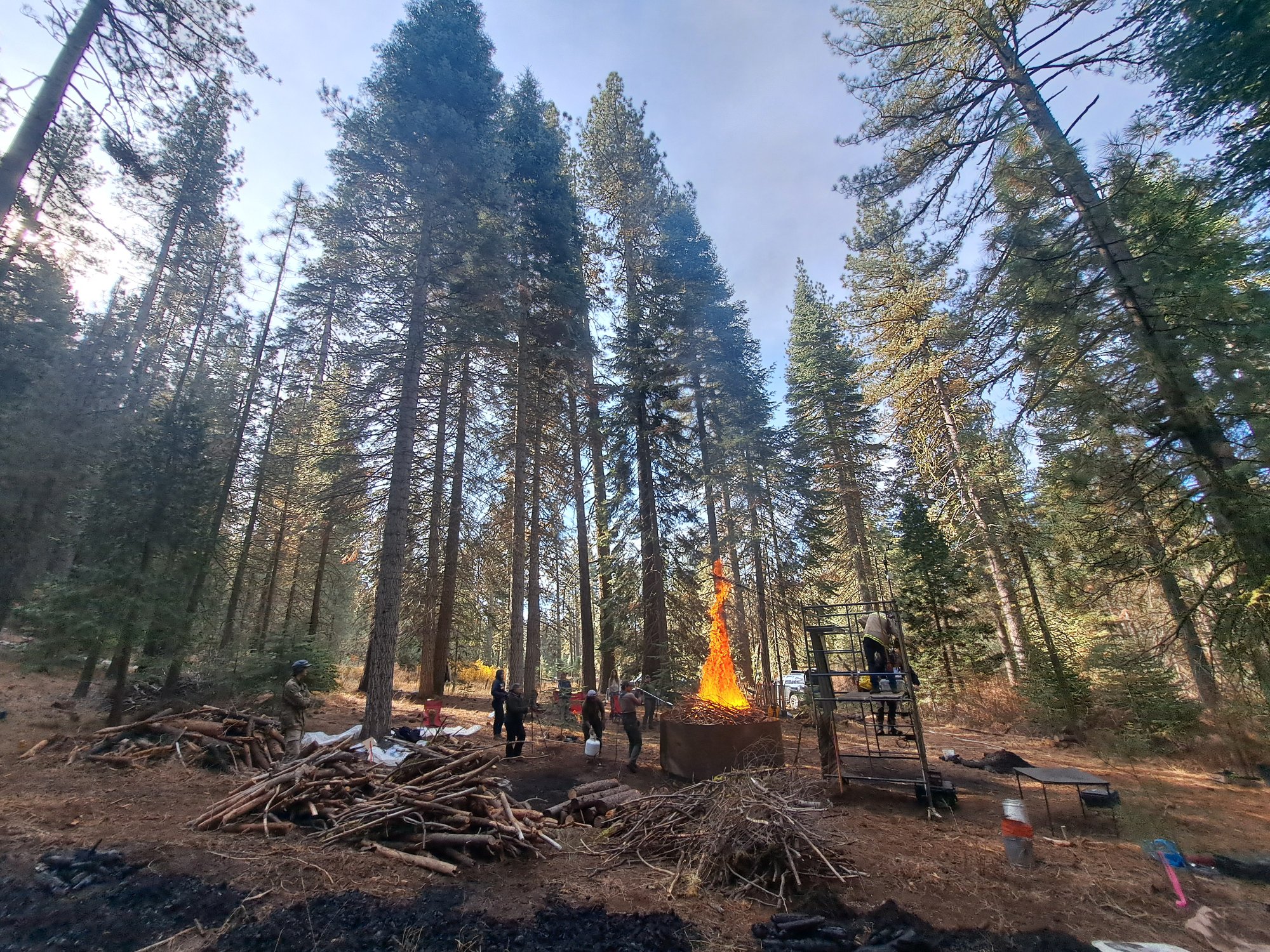
A flame-cap kiln — like the Ring of Fire kiln used by TPBA — is a large steel cone or cylinder that converts woody debris and slash into biochar through a controlled, low-smoke burn. The "flame cap" refers to the layer of active flame that forms across the top of the kiln, which acts as a natural afterburner — re-combusting the smoke-producing gases that rise from the burning material below and burning them off before they can escape into the air.
The result is a burn that is significantly cleaner than an open pile burn — less visible smoke, dramatically reduced ember cast, and a stable carbon-rich end product rather than ash that blows away.
Because kilns are mobile and can be brought directly to hazardous fuels on site, landowners don't need to haul debris off their property. The kiln comes to the fuel.
"One of the biggest challenges facing landowners who want to reduce fire risk on their land is finding the days when they can legally and safely burn. Kilns expand that window significantly. Less smoke means fewer air quality conflicts. Less ember cast means a safer burn with less risk of escape. That's a game-changer for communities like ours."
— TPBA Spokesperson
In Tuolumne County — and across the Sierra Nevada foothills — landowners who want to reduce fire risk face a narrow window when conditions are safe and legal for burning. Air quality regulations, wind, humidity, and fire behavior all constrain when and how fuels can be processed.
Flame-cap kilns address two of the most significant barriers directly:
The flame cap acts as a natural afterburner, re-combusting smoke-producing gases that rise from the burning material below and burning them off before they escape as visible smoke. This dramatically reduces air quality impacts and expands the number of days landowners can legally operate — including days when an open burn would be prohibited.
Open pile burns loft embers into the air, creating escape risk on even mildly windy days. Kilns contain combustion within the vessel, dramatically reducing the ember cast that makes open burns dangerous and unpermittable in many conditions.
Kilns can be transported directly to where hazardous fuels are located on a property, eliminating the cost and labor of hauling debris to a central burn pile. Fuel gets processed where it falls.
Together, reduced smoke and reduced ember cast mean landowners can process fuels on more days throughout the year — including days when traditional open burns would be restricted or unsafe — resulting in more hazardous fuel removed from the landscape annually.
The material produced by a flame-cap kiln isn't ash — it's biochar: a stable, carbon-rich amendment that improves agricultural and forest soils in ways that persist for centuries.
Biochar's porous structure absorbs and holds water in the soil profile, reducing irrigation needs and improving drought resilience — particularly valuable in the dry Sierra foothills.
Unlike ash or decomposing organic matter, biochar locks carbon into a stable form that persists in the soil for hundreds to thousands of years — turning hazardous wildfire fuel into a long-term carbon sink.
When inoculated with compost or liquid fertilizer before application, biochar becomes a home for beneficial soil microorganisms, improving overall soil biology and nutrient cycling.
Activated biochar can be applied to gardens, pastures, orchards, and forest soils. Tuolumne County's ranchers and small farmers can close the loop — processing fuels from their land and returning the benefit directly to their soil.
TPBA workshops cover biochar activation (inoculating with compost or liquid nutrients before application) and application rates appropriate for different soil types and land uses across Tuolumne County.
Join TPBA at Camp Earnest in Twain Harte for a full day of hands-on biochar making with Ring of Fire flame-cap kiln technology. Two shifts are available so you can choose what works for your schedule.
Participants will receive hands-on training in:
Natural fibers only — wool, cotton, or denim. No synthetic fabrics in a fire environment.
Sturdy boots and leather gloves. This is a working burn event.
Bring water and snacks for a half-day of outdoor work.
If you have one and are comfortable operating it, bring it. We'll put it to use.
Landowners, ranchers, farmers, fire practitioners, and curious neighbors. No experience necessary.
RSVP appreciated so we can plan accordingly. Walk-ins welcome.
The Tuolumne Prescribed Burn Association is a community-based organization that supports private landowners in conducting prescribed burns safely and legally on their own land. TPBA builds local capacity for fire stewardship through training, community burn events, and educational programming.
We don't burn for you — we burn with you. And we help you build the knowledge and capacity to lead burns on your own land, on your own terms.